Friday, 13 May 2011

THE MONTHS of May and September are when Scotland looks her best, I've always thought. The countryside at this time grows into its annual full maturity. Trees are fully clothed and walks with the dogs are beneath a canopy that has grown thick enough to effectively keep me dry from everything other than the worst downpours. And we had some of those a week ago when the overdue rain brought that long dry spell to an end. It rained steadily round here for three days. What was good was that it was a gentle precipitation, which seems to be the sexy new word the weather presenters use these days. That meant it sank into the ground and watered the growing plants rather than coming coming down in stair rods and flowing straight off the dry land into the watercourses.

Salmon in the rivers welcomed the rise in the river levels for it meant they could complete their annual migration back to the spawning grounds at the headwaters of their mother rivers and get on with the important job of reproducing future generations of the King of Fish. The River North Esk has seen loads of fish caught in pools, unable to move further upstream. Fishermen have reported seeing a lot of them suffering from disease. In recent days I've seen a 16pounder and an 8pounder taken from the river.

My wife Liz and I enjoy fishing together. We've fished for salmon, but really prefer taking a boat onto a loch and fishing for trout. My father taught me to fish when I was a youngster in short pants and I've fished all my life. Liz came to fishing about ten years ago and so often, to my considerable chagrin and frustration, she comes home with a bigger basket than me. This theory about pheronomes must have some truth in it. However I took the prize last Wednesday. Fishing Loch Tillypronie in Aberdeenshire she caught a very acceptable 1lb brown trout but, almost with my last cast when I was ready to throw the rod in the loch in disgust, I hooked a two pounder. It was the biggest trout I've ever caught - the size of a small sea trout. And, as she would with a small sea trout, Liz baked it. And very tasty it was too. We're not ones to use masses of herbs, preferring the sweet taste of the unadulterated meat. We'll be out together again several times before the season ends.

Wednesday, 30 March 2011

A good place to live

FIVE ROE deer, two red squirrels and a great spotted woodpecker, not to mention the tits and finches waiting in the wings to start their own breakfast when the big boys finish feeding on the peanut nets - not a bad haul when I rolled up the kitchen window blind first thing in the morning. I can't always expect such numbers of interesting visitors but none of them are so unusual that it's a special event.

We're lucky living where we do, on the edge of woodland at the foot of a glen, beside a river and sufficiently far away from any major urban centres for there to be little light pollution of our skies either daytime or night time. It all means that wildlife treats are relatively commonplace.

It's the time of year for much bird activity. Some, such as the mistle thrush and robin, are nesting already. We've a good population of thrushes spread throughout the woods around the house. I can't miss them when out with the dogs - perched on the very topmost branches of the tall old beech and fir trees, their ringing song challenging the world. Because they nest so early, when there is no foliage on the trees to camouflage them, they can get pretty aggressive if they have to defend their nest. A pair nested in the fork of an exposed gean (Scottish wild cherry) tree scarcely six feet off the ground and if I or the dogs went too close they became very agitated and scolded us loud and long until we cleared off.

There's an interesting range of birds of prey. I've watched a merlin take a blackbird that was feeding off the scraps that fell from the bird table, and strip off the breast feathers in preparation for lunch. Buzzards are so commonplace now I hardly bother to mention them. I'm certain there are more sparrowhawks in the woods than ever I see. The bird table is a happy hunting ground for them and from time to time I'm aware of a flash of barred fury making a dash at some unsuspecting song bird which has been singled out for tea. They are by no means always successful and will fly on if their prey escapes, but on one occasion I watched a sparrowhawk fly twice round the bird table in vain pursuit of I'm not too sure what - it all happened at what seemed the speed of light, and by the time the action was finished there wasn't a bird to be seen.

But the most exciting sightings were last year, of a pair of red kites that nested a quarter of a mile from the house. I hope they return this year. And I have to travel only about a dozen miles to see an osprey fishing on our local loch.

A sure sign that the sap is rising and young love is not far round the corner is the tap-tapping of the green and great spotted woodpeckers. We have so many elderly trees of different species for neighbours and no two sound the same, so that when the birds are engaged in a lively woodpecker paradiddle it sounds like a primitive woody xylophone. Most mornings I hear the strange yaffle of the green woodpeckers - the name for their call which which sounds like manic, barking laughter.

We regularly see four red squirrels fighting over the three peanut feeding stations. They give us possibly more pleasure than any of our other woodland visitors. I can't think of a better way to waste time usefully than sitting at our kitchen window, nursing a cup of coffee, watching the bird tables.

It's easy to forget that the world doesn't grind to a halt when the lights have gone out. I take my dogs out every night last thing and as often as not there's something of interest to report to my wife when we get back. Oyster catchers are essentially coastal birds which have been attracted inland during the spring and summer months to feed and to breed. They are active throughout the whole twenty four hours and the night time walks are always accompanied by their sharp "kleep, kleep" cries.

It's excellent habitat too for tawny owls. One calls "hoo hoo hoo" and its mate replies "keewick, keewick". They're keeping an eye on the intruders and letting the wood know the state of play.

We live not far from the River North Esk which is one of Scotland's best salmon rivers. Soon the spring run of fish will be making their way upriver to the headwaters where they will spawn and provide future generations of the King of Fish. I'll see them leaping the falls in their instinctive, traditional journey. They are at the end of an extraordinary life cycle which has taken them from their mother river to the waters around the Faroe Islands and Greenland where they have matured. They then make another mighty migration back to their mother river, having moved from fresh water to sea water and back again to fresh water, in order to breed.

One of the most exciting sights of nature is to see the fish fighting the watery element, single-mindedly determined to overcome waterfalls, rushing currents, anglers, otters, ospreys (in the River Tay) and whatever else nature throws at them so that continuation of their species is assured. If they didn't taste so good on the plate we'd never give them a second thought. Nowadays wild salmon is something of a rare treat compared with the farmed version, and we're prepared to pay a premium to buy one for the table. A couple of hundred years ago they were so plentiful that agricultural workers complained if they were fed salmon more than twice a week.

Sunday, 13 March 2011

Waking up at night

IT'S EASY to make the mistake, and I suspect that a lot of people do, of thinking that nature and the countryside are a daytime experience. It's like thinking of the sky as a daylight phenomenon only.

Another world comes alive when the sun goes down. There's a world of animals, birds, insects, plants - even human beings - for whom night time is their time of day. It's not as diverse a world as the daytime world, I grant you, but the countryside is a busy place when most of us have gone to bed.

I take my dogs out last thing before they settle down for the night and, as often as not, there's something to catch my interest. We live in a well-wooded area and with spring around the corner (provided there isn't any more snow!) tawny owls keep us company. They're warning each other about intruders, of course, but at this time of year if I stand at the back door in the dark for ten minutes and just listen, it's their courtship calls I hear. The females will be laying their eggs soon so the nuptials must be nearly complete.

A bird which is almost as active at night as in the daytime is the oyster catcher. From spring until the end of October the dogs and I hear their piping “kleep, kleep” calls on the night time walk. Some never seem to rest at all at night and if I wake up I listen for their sharp cries. Sometimes a small pack of them swoop over our rooftops all calling together and the noise is loud enough to wake me up.

They are really birds of the sea shore and cliff tops but have adapted their lifestyle, expanding inland into new breeding habitats. They feed in the soft mud of river banks and lochs and ponds, probing with their long orange beaks for worms and molluscs, and returning to the milder temperatures of the sea shore in winter when the prospect of frost means they can no longer forage in the frozen ground inland.

It's one of the few birds - ducks and geese are some of the others - that can be as active at night as they are during the day.


Thursday, 3 March 2011

Don't muck about with words

My working world is encompassed by words - individual words and how we use them, linking words to make phrases and how this appears to change the inherent meaning of the constituent words, how time and day-to-day usage change words. I like words, I enjoy using them. I like puns - witty plays on words; and similes and metaphors which are figures of speech - indeed perhaps 'figure of speech' is a metaphor in itself. But this blog is about idioms, or about one idiom in particular -

A narrow squeak - It's an interesting concept. How narrow must a squeak be before it can truly be said to be narrow? For purposes of comparison is there a regular or standard squeak and a broad squeak – and if so how can you identify them? Are we so accustomed to narrow squeaks that we can no longer recognise the regular and broad varieties?

Where can we find a narrow squeak? Are they scattered about like dead leaves or do we need to poke about in dark places. The phrase means "a disaster only just avoided" but if the disaster had been really terribly easily avoided would it then be a broad squeak, or perhaps a diminished squeak.

You see, nobody teaches you these things in school. They cram your head full of figures of speech and think they've done a good job. In reality they've left you ill prepared for the wider problems - you see, there we go again - that you'll encounter in life. Now I'm going to worry myself sick about where I can find one of those thin problems.

Friday, 11 February 2011

CEILIDHS ARE a deeply ingrained part of Scotland's traditional culture but, like so many things, their character has largely changed from the what is sentimentally described as the genuine, couthy, fireside gatherings of times long past. Old men told tales, wives and mothers sang the working songs of the district and, as pipers piped, young warriors danced over two crossed swords in a display of victory. It was the way local culture cascaded down generations, the way youngsters learnt their culture at their elders' knees and, in turn, handed it on to succeeding generations.

As often as not, what are billed today as ceilidhs are stage managed affairs with little of the spontanaity that we associate with impromptu gatherings in smoke-filled blackhouses with the cattle in the byre at one end of the building. However the spirit of such parties most definitely lives on.

For the past four years kind friends have filled their house with like-minded souls for "a night with the grand". If they don't call the event a ceilidh, it surely meets most of the criteria. So successful has it become that the event now extends to two evenings of singing and recitation. Dancing is not possible as only those with the most urgent and pressing alternative arrangements would dream of turning down their invitation, and the house is bursting at the seams both nights.

My wife is resident pianist which means I get to go both evenings
. It also means I have to have two party pieces but this has made me explore the songs and poetry of Scotland. My special love are the cornkisters and bothy ballads of the north east of Scotland and the work of poets like Violet Jacob, WD Cocker and Helen Cruickshank.

It has been surprising what a range of
talents has emerged from these evenings. Fine singers, memories of childhood in poems learned in the nursery and recalled with surprising clarity - and, of course, a piper. What fun these evenings are, and how they draw people together. No one is shy about performing and if they hit a bum note or have to refer to a crib to remind them of the next line of a poem, nobody thinks anything of it, and applause is no less sincere.

Such evenings benefit from food and drink and our hosts are generous in the provision of both. In the spirit of community other wives help out with contributions of puddings and the like and the performing is interspersed with breaks to restore our strength for the next session.

Gilbert & Sullivan songs were popular this year. Fifty years ago their songs were regularly sung at all sorts of entertainment but, as is the way of things, they grew less fashionable and fell out of fashion. Gilbert was the librettist and wrote clever, witty songs which were so well complemented by composer Sullivan's tuneful music. Three of this years company company had been ill and we came together to sing "When you find you're a broken-down critter" from "The Grand Duke" which is probably the least well-known of G&S's operettas. Our performance was masterly and we finished with a flourish to wild acclamation and demands for no more!

Must go, going out for supper - more will follow.


Friday, 28 January 2011

Philosophy of keeping dogs

HEY! LOOK at this - another blog so soon. My principal daily activity is walking the two dogs. It matters little how active or idle I may feel, the dogs need exercise and it's either me or my dear wife as has to do it. In many respects our animals are little different from us humans - they have needs and preferences and some of them have to be met or we humans must accept the consequences. So if I don't want smelly offerings on the carpet the dogs must have the opportunity to dispose of them outside.

Dogs have been part of my life all of my life - so much so that it is hard to imagine life without one. I complain about the onus, the millstone of keeping animals, the self-imposed burden of answering their daily needs. I groan when I think of taking them on holiday and not being able to lie-in every morning like normal people.

They take up room in the car, we must remember their beds and bowls and food, leads, the whistle - there's nearly as much fuss ensuring we leave nothing of theirs' behind as there is about our own packing. I swear at them, I shout. If it all ends up no fun for me, the dogs make it clear it's no fun for them.

Macbeth (white West Highland terrier), with his wee sawn-off legs is forever falling behind when we're out walking: Inka (black Labrador) is hyperactive and thrusts ahead. Our walks are punctuated with my bellows to Macbeth to catch up, and threats of hideous repurcussions if Inka gets too far ahead. You'd wonder why I keep them, indeed sometimes I do too. But they become part of life and provide someone like me with a focus to certain parts of the day. If I didn't have dogs I'd be fatter and lazier than I am already. And despite all the abrasive language and occasional ill will - because they have distinct minds of their own and are not frightened to try and exert them - they seem to think I'm just the sort of alpha dog they need to complete their circle of happiness. If they have to endure my ill-nature - well that goes with the territory.

Would I change things? Get rid of the dogs? Naah! Mostly we live together in comfortable harmony with only the occasional spat - much like the rest of life really.

So there's my philosophical rant for today. perhaps I'll be a bit more practical and down-to-earth next time.

Tuesday, 11 January 2011

Rising from the ashes of good intentions

IT'S EMBARRASSING to realise how long it's been since last I blogged. Good intentions expressed last year, for goodness sake, came to nothing but I'm awash with New Year purpose and 2011 is my year of the blog - so watch this space.

The purpose of this blog is to share my experiences of the countryside and the outdoors and to supplement my other, now, long term blog www.manwithtwodogs.com and hopefully direct other traffic to it. manwithtwodogs is in its ninth year now and appears each Saturday in the Dundee Courier newspaper. Writing my weekly article gives me the greatest pleasure which I believe is shared by a wide readership. I can't claim to be a great expert on all country matters but I know I know a lot more than some and that others know a great deal more than me. That doesn't matter really - what counts is protecting our countryside from our own human depredations so that we leave a legacy for future generations worth having. We humans are the only species on this earth who are capable of doing this and if we don't care about the world we live in we'll all come back in our afterlives as slimy, ugly creatures.

It isn't always necessary to do positive things. As often as not we can be effective by avoiding negative acts - the main thing is to care that whatever we do, or decide not to do, is undertaken with well-informed intentions.

Monday, 25 October 2010

Back from holiday

I'D HAVE been back blogging earlier but we've been on holiday in France for a fortnight. When we got home there was a pile of paid work to get through and that came first. It's all squared off now, so it's blog time again.

Our summer holiday was necessarily late this year because I took part in the Edinburgh International Book Festival. I may not get a chance like that again and I wasn't going to miss the experience for the sake of going on holiday which could be postponed - which it was. We stayed in a little narrow flat in the village of Lauzerte which is on the border of the Dordogne and the Lot. Lauzerte is considered to be one of the prettiest villages in France - a bastide village, which means it was built as a fortified settlement about 800AD on its hilltop site.

It has 360 degree views, as have so many villages and chateaux in that part of France. Perhaps it was all part of a defensive plan - they could all keep in touch and warn each other of impending danger. More will follow.

Friday, 1 October 2010

Not a breath of "fresh" air!


I smelt it before I saw it. The heron had been dead several days, lying hidden amongst the long grass by the roadside. I don't think I've come across a dead one before, and the process of decomposition was quite advanced. His - or perhaps it was her - eyes were crawling with tiny flies and even the dogs were put off by the rotting smell. But it's nature doing what nature does. The dead body will support all sorts of insects and worms and grubs, and before long only a pile of slate grey feathers will tell the tale that something that lived has been reclaimed.

In old Celtic mythology the heron was regarded as a bird of ill-omen. Perhaps it's the way it stands with its head hunched into its shoulders, looking as though it's contemplating villainy or evil. The novelist DK Broster in her classic Scottish novel "The Flight of the Heron", based on the 1745 Jacobite Uprising, describes how it was considered unlucky in those days to meet a heron when you set out on a journey. It all seems a bit hard on a bird that is shy and withdrawn.

There may be dignity in dying but, looking at that corpse, there's no dignity in death.

Thursday, 30 September 2010

Mother Earth!

Food for free, including home-grown tomatoes

Redcurrant jelly, raspberry jam, wild raspberry jelly, strawberry jam, rowan and apple jelly, gooseberry jelly, marmalade, opal plum jam, and now my indefatigable wife's latest find is a recipe for rosehip and apple jelly - they're all there in the photograph. Small wonder my centre of gravity slips ineluctably southwards with each creation from nature's bounty - all food for free - requiring only my time to pick them!

The rosehip and apple creation is deliciously moreish and a major hit with her home-made bread, bannocks and as an accompaniment to ice cream.

Actually, while the fruit is free, nothing else is. By the time you've paid for petrol to drive to where you're going to pick the fruit, paid for electricity and gas to boil it all up, and sugar to add to the boiling creation, it ends up quite an expensive exercise. But there's nothing to match the home made creation and you won't find anything to beat it on the supermarket shelves.

Wednesday, 29 September 2010

Not still waters

It has rained relentlessly for pretty well 24 hours. I took the dogs down to the river for their walk and watched the water pouring like brown Guiness or Newcy Brown - Newcastle Brown Ale to the uninitiated - through the tree lined gorge. It rammled and thrashed in torment between the high rocky sides and stormed on seawards in a torrent of white sound. The noise of the water blanks out everything, and for a while the mind is blank too while you come to terms with the sheer violence of what's happening in front of you. When the elements flex their muscles we puny humans have no response. But I know that the water level will fall as quickly as it rose, and in 36 hours we'll wonder what all the fuss was.


Drookit dogs!
They say there’s no such thing as bad weather,
just the wrong clothing.
How can I explain that to two damp dogs?

Half a dozen autumn run salmon had been resting in a pool preparing to run The Loups (or Leaps), a short series of waterfalls that they have to negotiate in the final stage of their journey to the headwaters to spawn and produce the next generation of the King of Fish. They'll be safely tucked away just now, close under the bank, to escape the destructive force of the spate.

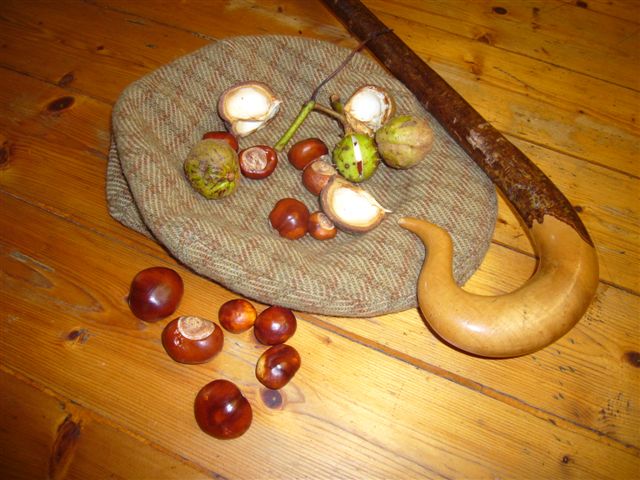
conkers

It may be autum, but the canopy of leaves on the trees lining the river bank provides a marvellous umbrella against the rain. It's mostly beech trees but there are fir trees, rowans, oak and sycamore and I can take off my cap because the worst I'll suffer is a few large drops that manage to break their way through the cover.

Thursday, 9 September 2010

Jam tomorrow, and tomorrow, and tomorrow

It's just not cricket! The rain it raineth every day.

The rain it raineth on the just
And also on the unjust fella,
But chiefly on the just because
The unjust steals the just's umbrella!

The beginning of September, we should be enjoying sunshine, farmers should be bringing in their harvest - the "hairst" in Scotland. The last of the wild harvest from the hedgerows is waiting to be picked. It's been pretty good so far this summer. I picked loads of wild raspberries which my wife boils up into the most delicious jelly. Our daughter brought us tiny plums which she turned into plum jam. There's been blackcurrant jelly, garden raspberries for jam and her marmalade, famous throughout three counties. And there's still more to come unless the wet weather rots the fruit on the bushes.

Folk should be more conscious of the countryside and what it offers. It takes about two hours to pick 5 lbs of wild fruit like raspberries, and I'm always surprised how easily and quickly my wife makes the jelly. She always make too much, but a jar of home-made produce is always a much more acceptable gift to give to a hostess when we go for dinner than a boring old bottle of wine. I think it's time I started to learn these simple countryside skills - but it will have to be next year now!

Wednesday, 1 September 2010

Words maketh blogger

The Edinburgh International Book Festival is an integral part of the The Edinburgh Festival and the Fringe Festival. Edinburgh, in the month of August, buzzez with people of every shape, size, colour, creed. Some are self-centred, some pushy, some reserved, even withdrawn - but, really, the greatest majority are fun people - and whatever I may think of individual foibles and imperfections, everyone is in Edinburgh to have fun and be part of the annual, amazing cultural (whatever that really means in this context)festivities. There's something for everyone from elevated to lower deck.


My contribution to the carnival was as a speaker at a Book Festival workshop last Monday with my co-author of "Sea Dog Bamse, WWII Canine Hero", Andrew Orr. The event was called "Selling The Story" and was targeted at would-be and struggling published authors looking for advice on marketing and how to get their book onto bookshop shelves.


Self and co-author Andrew Orr in the Writers’ yurt at the Edinburgh International Book Festival. We had just taken part in a workshop explaining how, working alongside our publisher, we marketed ourselves and our book and successfully turned it into Scottish best seller – Sea Dog Bamse, World War II Canine Hero ISBN: 978 1 84158 849 0

I've never bothered much with the Book Festival, and how I regret that now. But I've had three days at it this year and it's been an absolutely marvellous experience. What an idiot for not going before, but better late than never. I feel quite bereft at the thought that I shan't be playing with the big children again next year, with my pass to the writers' yurt (canvas encampment!) and talking to other writers I never expected to meet.

But I met and talked with other writers and found that some of my ideas were well received. It's so useful to hear their problems, but much more importantly, their successes - and see how I can put their ideas to work for myself.

And the workshop was a success. There's been positive feedback and I met the sister of one of my ushers at my wedding who I lost contact with about fifteen years ago. She bought my books and is taking them out to Canada when she visits her brother next week. A totally unexpected and welcome bonus.

I love meeting new people, I loved being part of the Book Festival - I want to do it again.

Tuesday, 24 August 2010

Just a busy month


Goodness, it's a month since I last blogged. It's so easy to start something like this with a flourish of enthusiasm and too easy to find excuses for not keeping up the activity. And it's been an interesting month that I could have shared.

I like good paintings - the sort where I know what the artist is painting. Liz and I went to an exhibition in Kirkcaldy Art Gallery of William McTaggart's paintings. There's a sort of a family connection there as McTaggart's second wife was my great-aunt Marjory, who was the eldest daughter of Joseph Henderson another painter and close friend of McTaggart.


Went through to the Kelvingrove Art Gallery in Glasgow to see the exhibition of the Glasgow Boys who outraged the art establishment of the day by having the audacity to paint outdoors, painting real people in real life. I love them because I can see what they are painting. You can't miss opportunities like these because the difficulties of putting together exhibitions of this stature means they are not going to be repeated in my lifetime.

I had a semantic tussle with myself about harebells and bluebells and which is Scotland's more representative flower. I decided it had to be the harebell, but it's interesting to note that a box Scottish Bluebell matches (made in Sweden, please note)has a spray of harebells decorating the lid.

We're having lots of fun watching the squirrels which come to the feeding stations outside our kitchen window. Four visit regularly, and there's also two or three woodpeckers which are really bonny birds. Some pundits say you shouldn't feed peanuts to birds, especially in the breeding season, because they will feed the peanuts to their chicks whose digestive systems can't cope. I've seen no reduction in young song birds and garden birds following their parents to the feeding stations, so I'm inclined to think that the parent birds feed themselves on the nuts but forage for easily digestible insects and bugs and creepy crawlies fopr their chicks.


You can't arrange some sights in nature to order. Walking with the dogs down the side of the River North Esk I stopped to watch a run of seatrout leaping up the waterfalls known as The Loups (Leaps) on their annual migration to the headwaters to spawn. They hurled themselves through the rapids in a series of spectacular leaps to reach the calmer water and the next step on their journey to the head of the glen.

Was at the Edinburgh International Book Festival in in Charlotte Square Gardens. Saw and introduced myself to Martin Bell, former BBC war correspondent and independent MP. Also Jim Naughtie whose cheerful tones wake us up most mornings. You can look on those folk from afar and wonder what they are like. Or go and talk to them and find out they're no different from the rest of us. If I sit on a tin tack and they do too, we'll soon realise the meaning of an early spring!

Monday, 26 July 2010

Food for free

We've been busy these past few days picking raspberries which the Doyenne has made into raspberry jam. The kitchen fills with the "moreish" smell of the boiling fruit which permeates through the house and moistens the taste buds. We don't use a great deal of jam ourselves but as soon as the family know that the new season's offering is on the store cupboard shelves they descend like vultures! It's also such a good present for hostesses who invite us for dinner - much more personal than a bottle of wine or a box of chocolates.

Gooseberries will soon be ripe. The dogs and I pass two bushes in a beech hedge every morning which are probably escapees from a garden - so they are what you might call semi-feral. Some time, a long time ago, a bird has eaten a cultivated garden gooseberry, and several of the seeds passing through its system have popped out the other end in the way these things do, and have self seeded in the wild. Very versatile fruit are gooseberries.

Wild raspberries are just about ready for picking too. The Doyenne makes the most delicious jelly from these, and I make raspberry vodka. If everything ripens at once, this week may be even busier than I expected.

Wednesday, 21 July 2010

Beyond the kitchen window

Wee braveheart

Wednesday - this morning the cows and their calves were lying down again when the dogs and I passed the gate into their field. Several of the cows got to their feet with that awkward, laboured action they have, protective of their young from canine intruders. How anything as big as a cow could expect danger from anything as small as Macbeth, I cannot imagine. But Macbeth holds his ground with cows and when they come sniffing through the fence at him he stares them out and barks at them with his wee high-pitched bark. Surprisingly the cattle scatter in fright and Macbeth swaggers off with his tail in the air.

On the other hand our black Labrador Inka would like to be perceived as bold and fearless. As soon as the cattle blow down their nostrils at him he turns and bolts with his tail between his legs.

By the time we got back home it was raining again. It'd mid-July and I'm thankful we're not on holiday in this soggy part of the world.

Tuesday, 20 July 2010

Something to ruminate on

When cattle lie down in a field most folk think, understandably, that they are chewing the cud.

Cattle are ruminants, which doesn't mean that they have four stomachs - a common misconception - but that their single stomach has four compartments which allows them to chew their food once, regurgitate it and chew it (the cud) a second time. One of the side effects of this is that ruminants produce methane gas which is one of the unwelcome greenhouse gases threatening the world. "Fart" taxes have been proposed to fund research into how to reduce this antisocial behaviour.

But to get back to my original discussion - most ruminants prefer to lie down when they are 'chewing the cud' because there is an element of stress while doing so.

Sheep, goats deer and even giraffes are also ruminants. After you know about their rather bizarre digestive habits you might wonder why we eat them. I've eaten beef, mutton, venison and goat meat - and there's still the first time for giraffe - and I reckon I can cope with their whiffy habits.

But to get back to my original discussion - the old greybeards reckoned they - the cattle, that is - can smell rain coming and lie down so that they have a dry, warm patch of pasture to rest on while the bad weather lasts. Sunday and Monday, out walking the dogs first thing, the cows and their calves in the field at the back of the house were all lying down, and the greybeards were borne out because the rain came down in torrents. This morning they were all standing and feeding - the cattle, again - and now the clouds are high in the sky and it's sunny.

Sunday, 18 July 2010

better pasta sauce

The Doyenne came up with a good idea to improve her pasta sauce. There were a couple of thick, outside stalks of celery in the vegetable box which she cut small and added to the rest of the ingredients. The smell of the celery was noticeable before I took the first mouthful and the taste added extra zing to an already delicious meal.

I'm a bit of a dab hand at pasta sauce myself and my recipe can be found in my book "Tales from the Scottish Countryside - New Walks with the Man with Two Dogs" Black & White ISBN 978 184502257-0.

I can't claim to be any great shakes as a cook but I know enough now to be able to look after myself if I have to. And I realise that cooking isn't the black art I once thought it was; a lot is plain common sense. A bit of trial and error, a little patience and I reckon I'd get by. But as long as I'm as well looked after as I am there's no urgency to try to do better!

Mushroom delight

Out walking with Cait, James and their dog Rosie, and Liz and our two bold boys, saw the first chanterelle mushrooms. It seems very early compared with previous seasons. I'll look in the favourite spots and see if there's enough to fry with bacon for breakfast.